











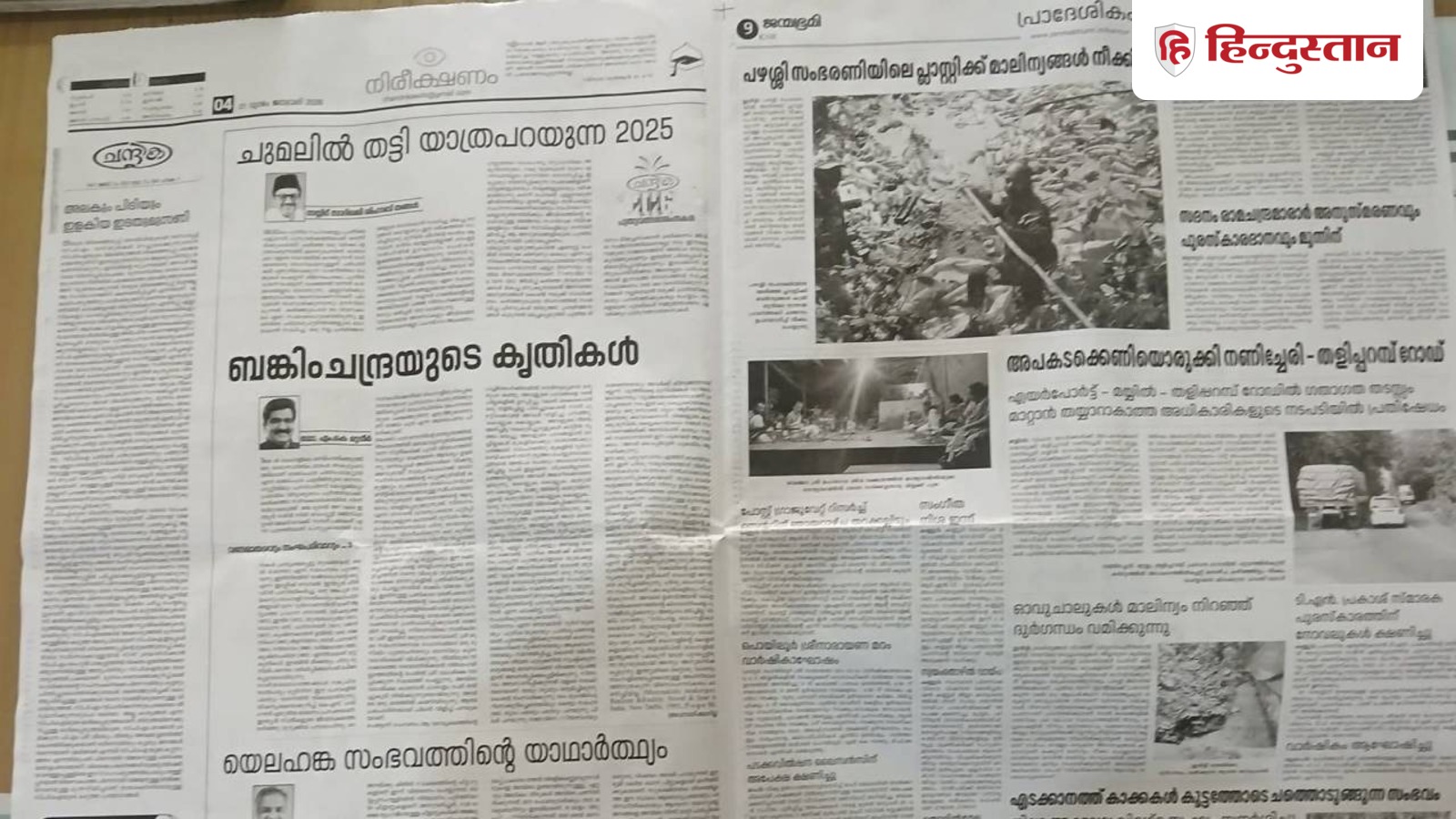
Readers of Kerala’s Janmabhumi woke on Thursday to an unexpected sight: the paper’s editorial page, normally aligned with the Bharatiya Janata Party’s viewpoint, instead carried columns and an editorial from the Muslim League’s publications.
The anomaly affected Janmabhumi editions distributed in Kozhikode and Kannur, where the front editorial page featured a year‑end review by Muslim League leader Sayyid Sadiqali Shihab Thangal. Additional pieces by senior party figures M.K. Munir and Mohammad Shah appeared on the same page, while the editorial itself matched the text running in the League’s mouthpiece, Chandrika, criticising recent local body elections and suggesting disarray in the Left Democratic Front (LDF).
India newspaper printing error
Janmabhumi management quickly conceded the material was published in error and attributed the incident to a technical and human lapse at a private pre‑press centre that produces plate files for multiple newspapers. According to the publisher, plates intended for Chandrika were mistakenly routed to Janmabhumi’s printing section, so thousands of copies rolled off the press containing rival party content.

Journalists and press‑industry sources say it is common for several regional titles to farm out plate‑making to the same facility to save time and cost. When an incorrect plate set is sent to a press, the result can be widespread distribution of unintended material. In this instance the mistake became visible only after printing and distribution had begun.
The misprint immediately became a political talking point. Opposition parties, particularly the CPI‑M, seized on the episode with sarcastic commentary on social media, suggesting a secret understanding between the BJP and the Muslim League. Party spokespeople used the incident to score political points, while local readers shared photographs of the pages widely online.
Janmabhumi issued a public apology, calling the episode a case of ‘‘printing press negligence’’ and promising an internal review to identify procedural failures and prevent recurrence. The management said there was no deliberate editorial interference and that the mishap would be investigated with the private centre responsible for plate production. By the time the apology was published, images of the misprinted pages had already circulated extensively.
The episode highlights operational vulnerabilities in regional print production where multiple titles share pre‑press services. Media analysts say the incident is unlikely to have long‑term consequences for the involved parties, but it nonetheless underscored the speed at which local errors can become national stories in the age of social media.
For readers and newsrooms alike, the case is a reminder of the importance of redundant checks in pre‑press workflows. Publishers that rely on third‑party plate makers and printers may need to tighten verification protocols and introduce last‑minute plate confirmations to ensure editorial integrity and avoid costly reputational fallout.
As the local political debate continues online, Janmabhumi’s management has pledged corrective measures. Officials at the private centre have not yet issued a public statement, and both the centre and the newspaper say they will co‑operate with any further inquiries from industry bodies or regulators.
Key Takeaways:
- An India newspaper printing error led Janmabhumi’s Kozhikode and Kannur editions to carry Muslim League editorials and columns.
- The pages included pieces by Sayyid Sadiqali Shihab Thangal, M.K. Munir and Mohammad Shah, and an editorial from Chandrika.
- The publisher blamed a private platen centre mix-up during the printing process; thousands of copies were affected.
- Opposition parties mocked the incident on social media while the paper apologised and launched an internal review.








