











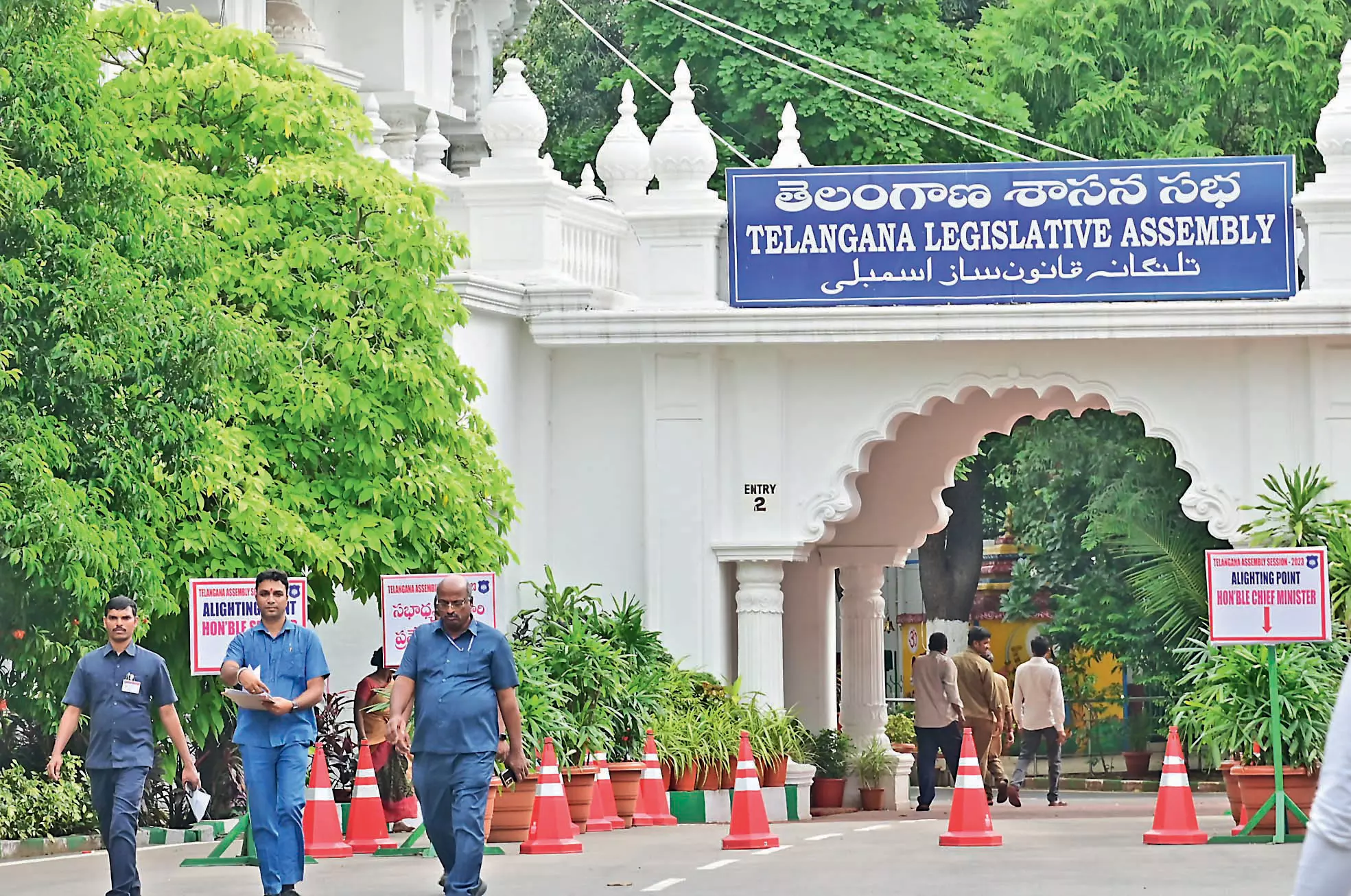
The Telangana Legislative Assembly reconvened on Friday with sharp exchanges expected as politicians prepare to argue over river water sharing and irrigation projects that have long divided the state.
Chief Minister A. Revanth Reddy intensified the political temperature at a meeting on Thursday with Congress MPs, MLAs and MLCs, accusing his predecessor K. Chandrashekhar Rao (KCR) of failing to address pressing water distribution issues. Mr Reddy urged Mr Rao to attend Assembly sessions and face the treasury benches without fear of heckling.
Telangana water politics dominate the agenda
At the top of the agenda are disputes over Krishna and Godavari river water sharing, and the progress of ongoing irrigation schemes. The Congress government says it will push for detailed debates and accountability on allocations and project implementation, arguing that recent decisions have direct consequences for farmers, urban water supply and regional development.

Opposition members, many aligned with the Bharat Rashtra Samithi formerly led by Mr Rao, are expected to resist what they describe as politically motivated attacks. They maintain that the complexity of inter-state water agreements and central-state relations complicate the situation and require careful negotiation rather than theatrics on the Assembly floor.
Officials point out that irrigation projects in Telangana are tied to multi-year timelines and statutory arrangements with neighbouring states. Analysts say the Assembly debates will test the state government’s capacity to translate policy promises into tangible water management outcomes and infrastructural delivery.
What to expect from the debates
Parliamentary observers predict intense exchanges over budget allocations for irrigation, the status of key projects and the administration’s prioritisation of river-linking or modernisation efforts. There will likely be demands for progress reports, timelines and explanations of any delays. Lawmakers representing agrarian constituencies will press for clarity on water allocations ahead of forthcoming planting seasons.
Beyond immediate policy concerns, the confrontations carry political weight. Mr Reddy’s public remarks calling out Mr Rao were aimed at consolidating his party’s position and signalling that the government will take an assertive stance on governance matters. For the opposition, the Assembly offers a platform to challenge the government’s record and rally support among constituencies affected by water stress.
Administrative sources say the session may include committee references and calls for fact-finding on specific projects. Depending on how debates proceed, the Assembly could also see motions demanding intervention by central authorities or judicial review if members allege violations of statutory water-sharing arrangements.
For citizens, the outcome of these debates matters in practical terms. Water security influences cropping patterns, livelihoods and industrial supply chains across Telangana. Improved transparency and timely execution of projects are among the authorities’ stated objectives, but achieving those outcomes will require consensus-building across political lines and with neighbouring states.
As the Assembly sits through its agenda, all eyes will be on whether the session produces substantive policy decisions or primarily serves as a forum for political point-scoring. Either way, Telangana water politics are set to remain a defining issue in the state’s governance calendar for the weeks ahead.
Key Takeaways:
- Telangana Assembly reconvenes amid rising debate over Krishna and Godavari water sharing.
- Chief Minister A. Revanth Reddy challenges former CM K. Chandrashekhar Rao to attend the House without fear.
- The ruling Congress is set to press for scrutiny of irrigation projects and water allocations.
- Water politics are likely to dominate proceedings and shape state-level governance in the coming days.








