











Key Takeaways:
- The Iran Ali mural, a large digital work by Hassan Rouh‑ol‑Amin, was unveiled at the Vali Asr and Jomhuri intersection in Tehran.
- The piece was produced in the Maktab Haj Qassem and incorporates a poem by Fa’ezeh Amjadian in the calligraphy of Mohammad Rouh‑ol‑Amin.
- The public installation highlights Iran’s investment in contemporary public art and cultural expression.

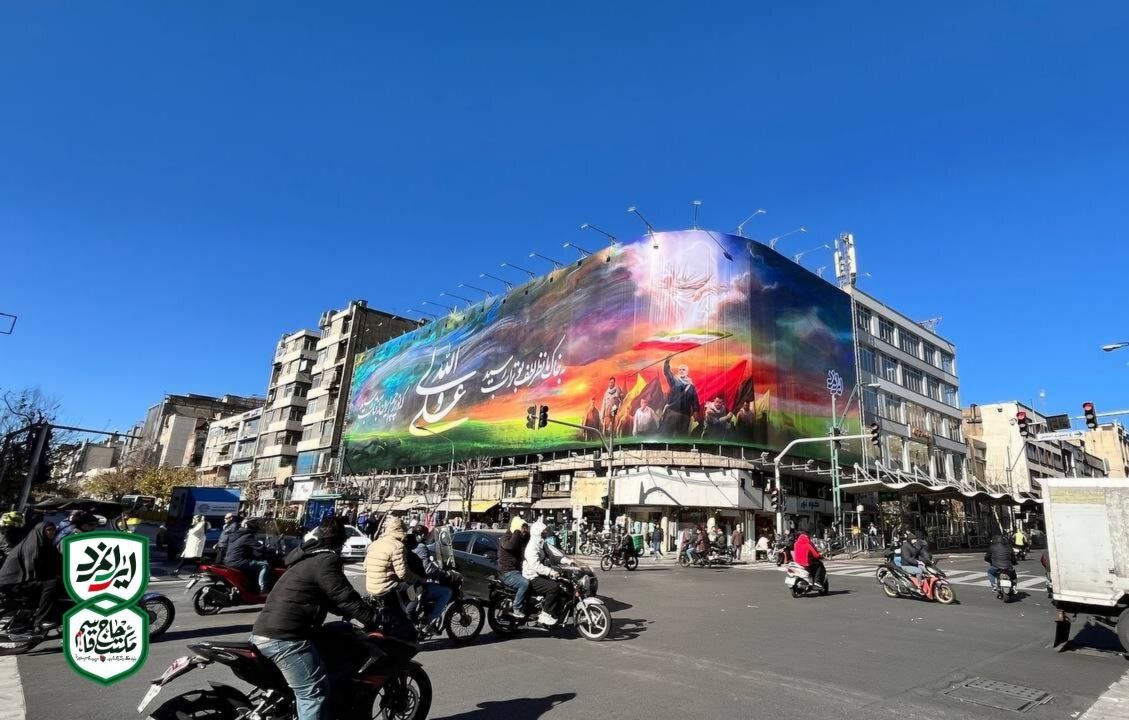
A large digital mural titled “Iran Ali” by artist Hassan Rouh‑ol‑Amin was unveiled this week at the busy intersection of Vali Asr and Jomhuri streets in central Tehran, Mehr News reported. The work, produced in the Maktab Haj Qassem, was revealed to passersby in a public ceremony attended by local officials and residents.
Iran Ali mural draws attention at Vali Asr and Jomhuri
Positioned on a prominent wall where two of the city’s main arteries meet, the Iran Ali mural combines contemporary digital painting with traditional calligraphic verse. A poem by Fa’ezeh Amjadian has been incorporated into the composition in the hand of calligrapher Mohammad Rouh‑ol‑Amin. The lines read: “به خاک ما نظر لطف بوتراب رسید / که نور پرچم ایران به آفتاب رسید,” which were rendered alongside the central imagery to create a dialogue between text and visual form.
The artist, Hassan Rouh‑ol‑Amin, produced the piece within the framework of the Maktab Haj Qassem, a cultural initiative that has supported a number of public art projects in recent years. The mural’s digital origins allowed the design to be reproduced precisely at scale, while the calligraphy provides a human, handcrafted element that anchors the work in Iran’s long visual traditions.
Local art commentators noted the significance of placing a large‑scale mural at such a highly frequented urban junction. Public artworks of this scale can shape the day‑to‑day experience of city residents, offering moments of reflection amid traffic and commerce. Observers said the mural’s combination of national imagery and poetic verse aims to foster a sense of shared cultural identity without being didactic.
Public art commissions in Tehran have increased in recent years, reflecting municipal efforts to revitalise urban spaces and to promote cultural expression in the public realm. This installation follows other recent projects that have emphasised collaborative production, bringing together digital artists, calligraphers and cultural organisations.
The inclusion of Fa’ezeh Amjadian’s poem, rendered by Mohammad Rouh‑ol‑Amin, was highlighted by organisers as a deliberate choice to blend contemporary visual practice with literary tradition. The poem’s words were integrated into the mural’s composition so they are legible from street level, inviting viewers to stop and read as well as observe.
Photographs of the unveiling show the mural occupying a large façade, its colours and forms visible from multiple approaches to the intersection. The work was published alongside the official announcement, and images circulated quickly across social and local news channels, generating commentary from residents and art networks.
While the mural’s subject and title are local in focus, cultural initiatives such as this contribute to a broader conversation about Iran’s contemporary creative scene. Public art can operate as a soft form of cultural diplomacy, making visual statements in everyday urban settings.
For now, the Iran Ali mural stands as the latest addition to Tehran’s public art landscape. Organisers say the installation will remain in place as part of an ongoing commitment to support accessible cultural projects that engage the city’s diverse public.








