











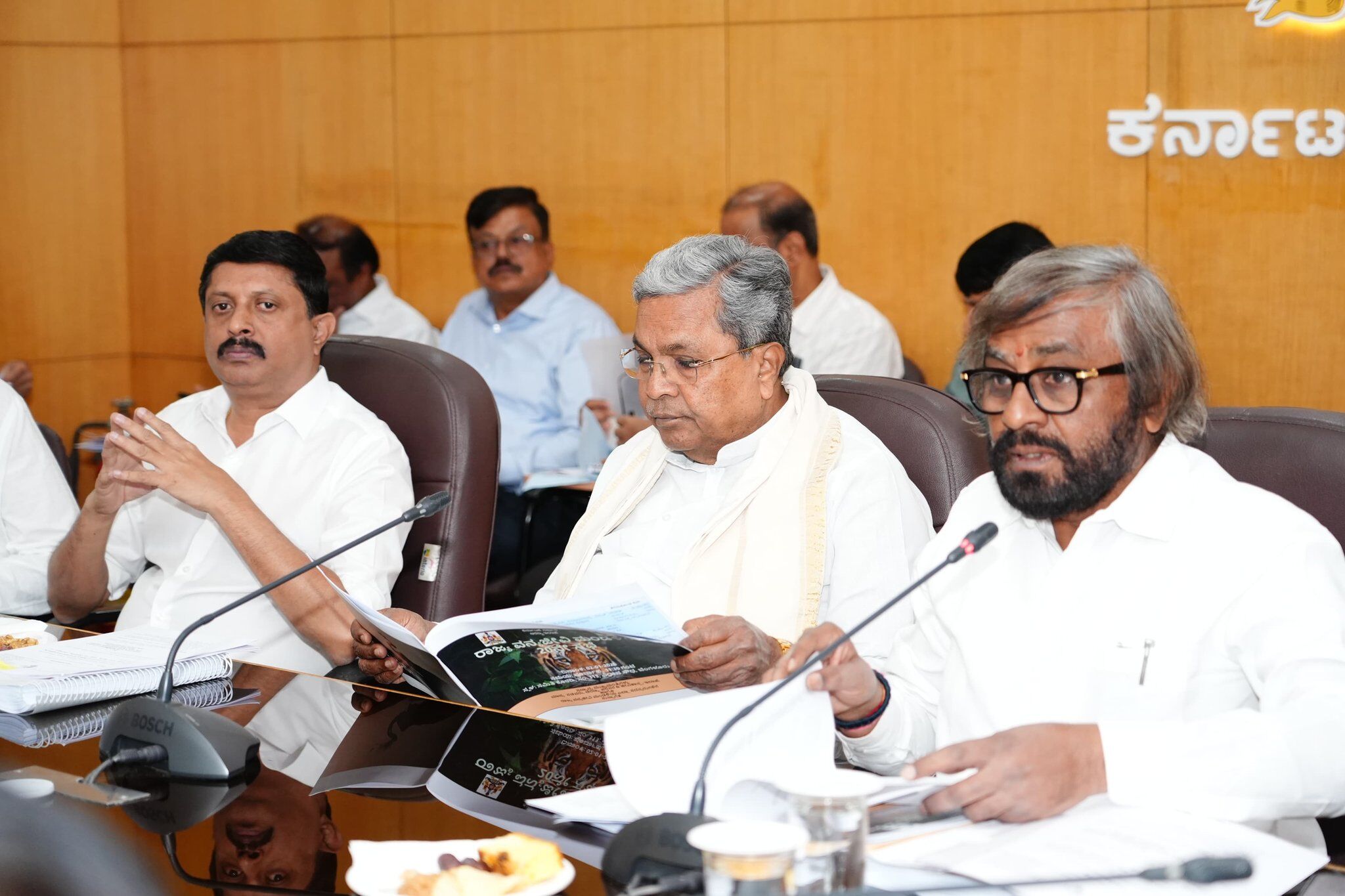
Chief Minister Siddaramaiah has instructed officials to form a technical expert committee to study whether safari vehicle noise and lights are prompting wildlife to leave forests and to assess the carrying capacity of safari operations in Bandipur and Nagarahole. The announcement came during the 20th meeting of the State Wildlife Board at Vidhana Soudha on Friday.
Bandipur safari study to assess wildlife behaviour and carrying capacity
The panel is expected to include wildlife specialists and other experts who will reassess decisions on safari operations with an eye to both conservation and local employment. The move aims to ensure that forest tourism continues to generate livelihood opportunities without compromising animal safety or habitat stability.
Forest Minister Eshwar Khandre told the meeting that safaris were suspended in Bandipur and Nagarahole after a series of tiger attacks in October and November resulted in three fatalities and left one person permanently incapacitated. The state ordered a halt to safaris until further notice, and officials reported that no attacks or loss of life have been recorded during the two-month suspension.

Local residents and farmers have long alleged that the noise and lights from safari vehicles encourage wildlife to stray from forest areas. The proposed Bandipur safari study will investigate these claims and produce recommendations on whether and how safari operations should resume. Forest department officials have noted that only a small fraction — estimated at around 8 per cent — of the forest area is used for safari activities, and that tourism plays an important part in local livelihoods.
Officials also highlighted a substantial rise in tiger numbers in Bandipur over recent decades. Records show around 12 tigers in 1972, compared with an estimated 175–200 today. Experts typically advise that a single tiger requires approximately 10 square kilometres of territory to roam freely; the current tiger density in the roughly 900 square kilometre forest is therefore substantially higher than that guideline, a factor officials say may also be contributing to increased movement of wildlife into inhabited areas.
Anil Kumble, the principal secretary for forests and wildlife, stressed that wildlife movements are not necessarily linked to safari operations. He argued that the proportion of forest used for tourism is limited and that the impact of safaris on animal behaviour needs careful, evidence-based assessment.
Local elected representatives raised concerns about the effect of the safari suspension on community incomes and the wider tourism sector. MLA Ganesh Prasad said the halt had hit livelihoods and placed a strain on businesses dependent on visitors. The expert committee will therefore be asked to consider both ecological data and socio-economic impacts when making its recommendations.
Present at the meeting were Minister Bhairati Suresh, the Chief Minister’s political secretary Naseer Ahmad, Additional Chief Secretary Anjum Pervez, Principal Chief Conservator of Forests Meenakshi Negi and Chief Wildlife Warden P.C. Ray among others. The government has not yet set a public timeline for the committee’s report, but officials indicated the review would aim to balance wildlife conservation with the needs of local communities and the tourism industry.
Key Takeaways:
- Chief Minister Siddaramaiah has directed the formation of a technical expert committee to conduct a Bandipur safari study on wildlife movement and park carrying capacity.
- The decision follows a temporary suspension of safaris after tiger attacks; officials report no further attacks during the two-month halt.
- Rising tiger numbers and local claims that safari vehicle noise and lights push wildlife out of forests prompted the review.
- The committee will weigh conservation needs against local livelihoods and tourism interests.







