











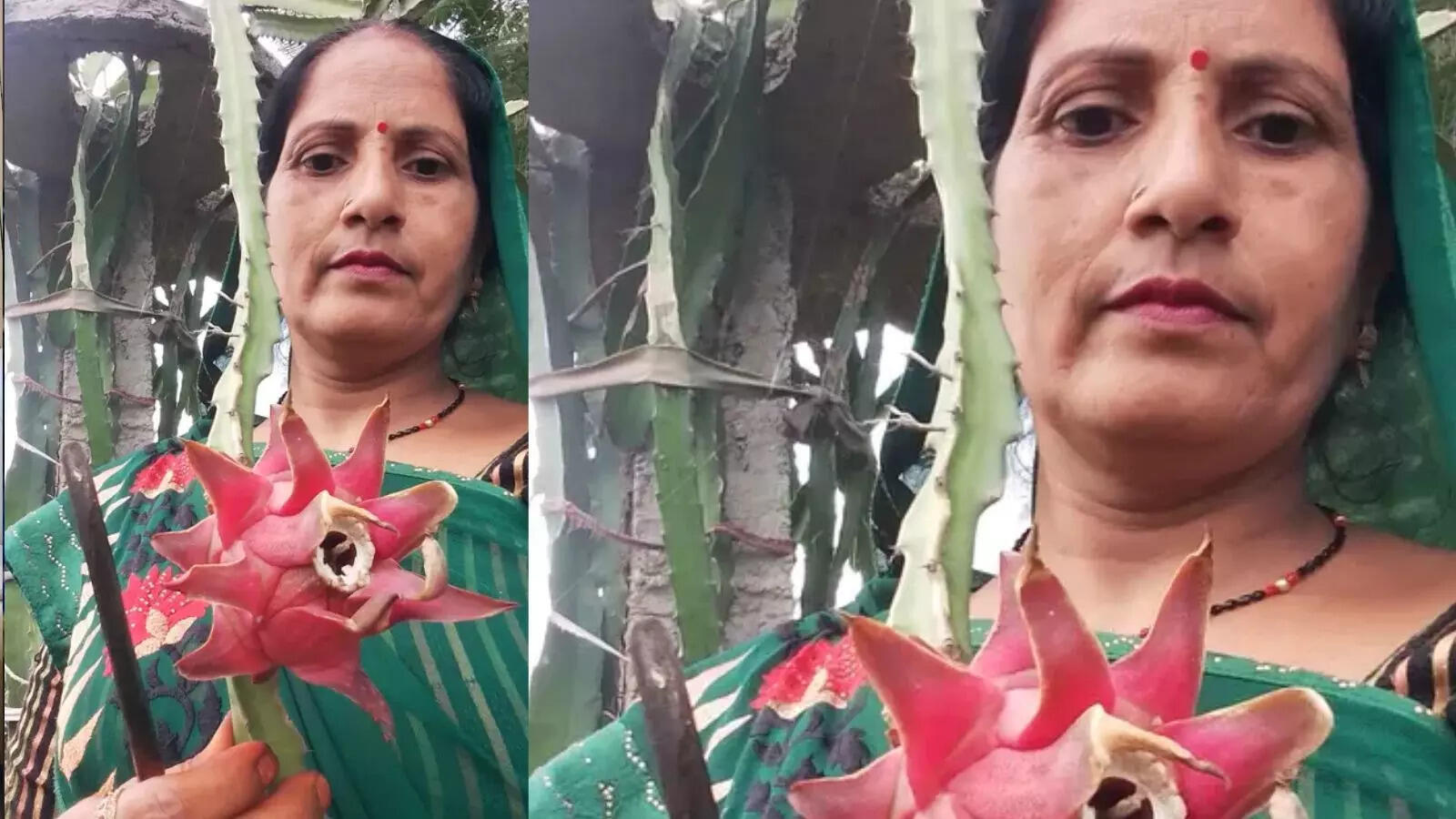
Mantrawati Shakya, a resident of Bhatora village in Etawah district, Uttar Pradesh, has turned limited resources into a sustainable livelihood and a model for rural empowerment. Through a combination of crop diversification, disciplined cultivation and local training initiatives, she now earns about Rs 3 lakh a year and has become a recognised example of Indian rural entrepreneurship.
Indian rural women entrepreneurship modelled by Mantrawati Shakya
Educated to the eighth grade, Mantrawati began adapting her farm practices during the challenges of the Covid-19 pandemic. She now cultivates strawberry on one bigha, harvesting from October to March; dragon fruit across three bigha, which offers a long-term return on a one-time investment; and ragi, a hardy coarse cereal that matures in five to six months. Together these enterprises have provided steady income and reduced her household’s vulnerability to seasonal shocks.
The state government’s rural development initiatives under Chief Minister Yogi Adityanath, with an emphasis on self-help groups and livelihood missions, have supported her progress. Local NRLM group facilitators have helped link women to bank accounts and government schemes, often requiring only basic documents such as an Aadhaar card, a bank passbook and a photograph.

Mantrawati’s work goes beyond her own farm. She has trained more than 50 women across different blocks of the district in modern cultivation techniques and advocates grouping 12 to 15 women into self-help groups to open new income avenues. Her approach combines practical crop choices with simple record-keeping and market awareness, enabling women with limited formal education to become entrepreneurs in their own right.
Her achievements have received official recognition. Mantrawati has been honoured twice by the Chief Minister and has been invited as a special guest to represent the state at the Republic Day parade on Kartavya Path in New Delhi. The selection underscores both her personal success and the visibility of grassroots women’s enterprises in state policy.
Officials from the State Rural Livelihood Mission say the programme aims to transform 30 lakh self-help group women into ‘lakhpati didi’ beneficiaries and ultimately expand the outreach to one crore rural women over coming years. Janmejay Shukla, Joint Mission Director, described a comprehensive support package: technical assistance, expert training, product development, packaging and market linkages to ensure enterprises are viable and scalable.
Practically, the model relies on scalable crops and simple value-addition. Dragon fruit, for instance, requires an initial investment but can generate returns for many years. Strawberry provides a high-value seasonal crop, while ragi adds food security and a quick cash flow during the year. When combined, these crops reduce risk and smooth household incomes.
For policymakers and development practitioners, Mantrawati’s case offers lessons. Targeted training, easy access to financial services, and efforts to create market linkages are central to replicating this success. Encouraging collective action through self-help groups helps smallholders access inputs, negotiate prices and invest in post-harvest processing or packaging that raises product value.
As states and national missions pursue ambitious targets for women’s livelihoods, the story from Bhatora village demonstrates that modest plots, relevant technical support and organised groups can produce measurable economic gains. Mantrawati Shakya’s journey from smallholder to trainer and state representative highlights the potential of Indian rural women entrepreneurship to contribute to rural prosperity and wider economic inclusion.
Key Takeaways:
- Mantrawati Shakya from Etawah, India has built a steady income of about Rs 3 lakh a year through strawberry, dragon fruit and ragi farming, illustrating Indian rural women entrepreneurship.
- She trains more than 50 local women in modern farming and promotes self-help groups linked to government schemes such as NRLM.
- The state mission aims to scale this model to 30 lakh women and eventually one crore rural women with technical support, packaging and market access.








