











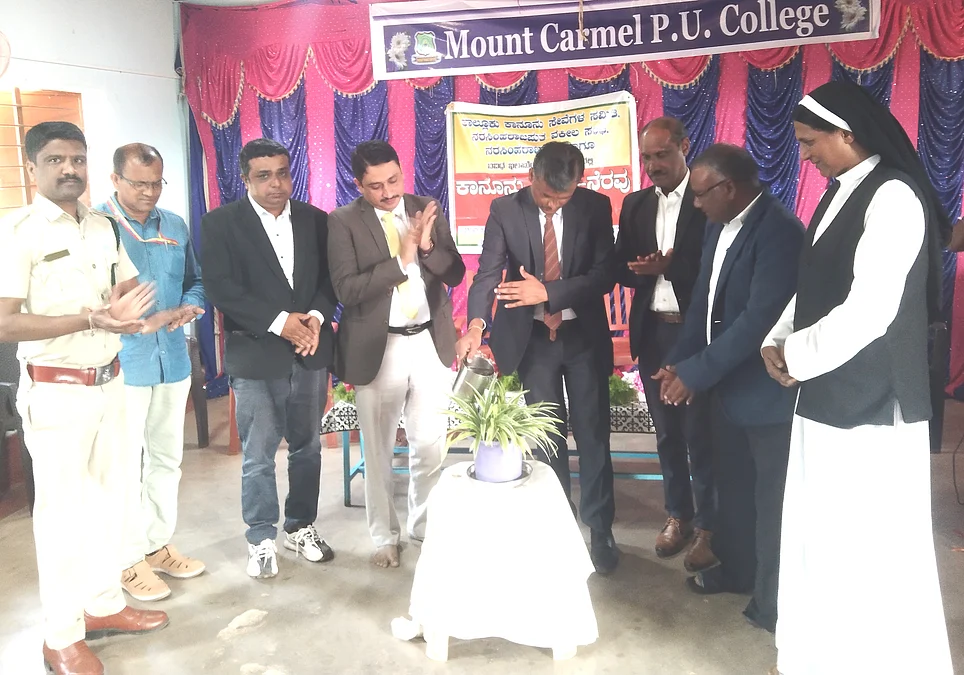
Senior Civil Judge K.T. Raghunath Gowda called for stricter adherence to traffic and environmental laws during a public awareness programme held at Mount Carmel Pre-University College in Menasuru on Tuesday. Organised jointly by the taluk law service authority, local bar association, assistant public prosecutor’s office, taluk health department and divisional forest officials, the event combined road safety advice with environmental legal literacy.
Road safety and environmental awareness
Addressing students and community members, Judge Raghunath Gowda warned that no one under the age of 18 should drive under any circumstances. He reminded the audience that violating this rule could attract fines of up to ₹25,000. Motorcyclists must carry a valid driving licence, vehicle insurance and registration documents, and must wear helmets at all times. Drivers of four-wheeled vehicles were told that seat belts are compulsory.
The judge also urged students to familiarise themselves with laws that protect young people, including provisions under POCSO that aim to prevent sexual offences against minors. He said the law has been implemented to curb exploitation and that communities should report instances of child marriage or other abuses to the taluk law service authority for prompt action.

Speakers stressed that legal knowledge is essential for daily life. Students were advised to focus on their studies during the PUC stage, keep their minds steady and seek help if they encounter legal or social problems in their home areas.
JMFC Civil Judge R.S. Jeetu drew attention to forest protection measures, noting that forest conservation laws introduced since 1986 place responsibility on every citizen to protect the environment. He encouraged the community to reduce plastic use, favour cloth or paper bags and take measures to make the country free of single-use plastics. “Forests are shrinking and wildlife habitats are under threat,” he said, urging residents to conserve water and show compassion for all animals.
Divisional forest deputy officer B. Nandish reinforced the message, recalling that traditional practices of revering trees and animals were rooted in conservation. He explained that enforcement of the Forest Conservation Act and the Wildlife Protection Act is intended to curb pollution and prevent further habitat loss.
Legal professionals present at the programme shared practical information. Taluk Bar Association president K. Jayaprakash provided guidance on registration and death certificate procedures. Lawyer Paul Cherian spoke about environmental law literacy and its implications for local communities, while public prosecutor G.B. Nekar discussed cybercrime awareness.
The college principal, Sister Shuba, chaired the event. Health education officer P.P. Baby, lecturers Nandini Alanduru and Anusha, and students Crystal, Darshana and Jesna also attended and contributed to discussions.
Organisers said the aim was to equip young people with legal knowledge and practical safety habits that protect both human life and the natural environment. They urged students to report incidents like child marriage or sexual offences and to adopt environmentally responsible behaviours such as reducing plastic use and conserving water.
The programme combined legal instruction, public safety directives and environmental stewardship, reflecting local officials’ intent to foster safer roads and healthier ecosystems through community engagement and legal awareness.
Key Takeaways:
- Local officials and judges urged strict observance of traffic laws and penalties to improve road safety, emphasising road safety and environmental awareness.
- Under-18s were warned against driving; helmet, licence, insurance and seat documents are mandatory for two-wheelers, and seat belts required for four-wheelers.
- Speakers highlighted legal protections including POCSO and actions to halt child marriage, and urged students to report offences to authorities.
- Officials called for reduced plastic use, forest protection and compassionate treatment of all wildlife to preserve local ecosystems.








