











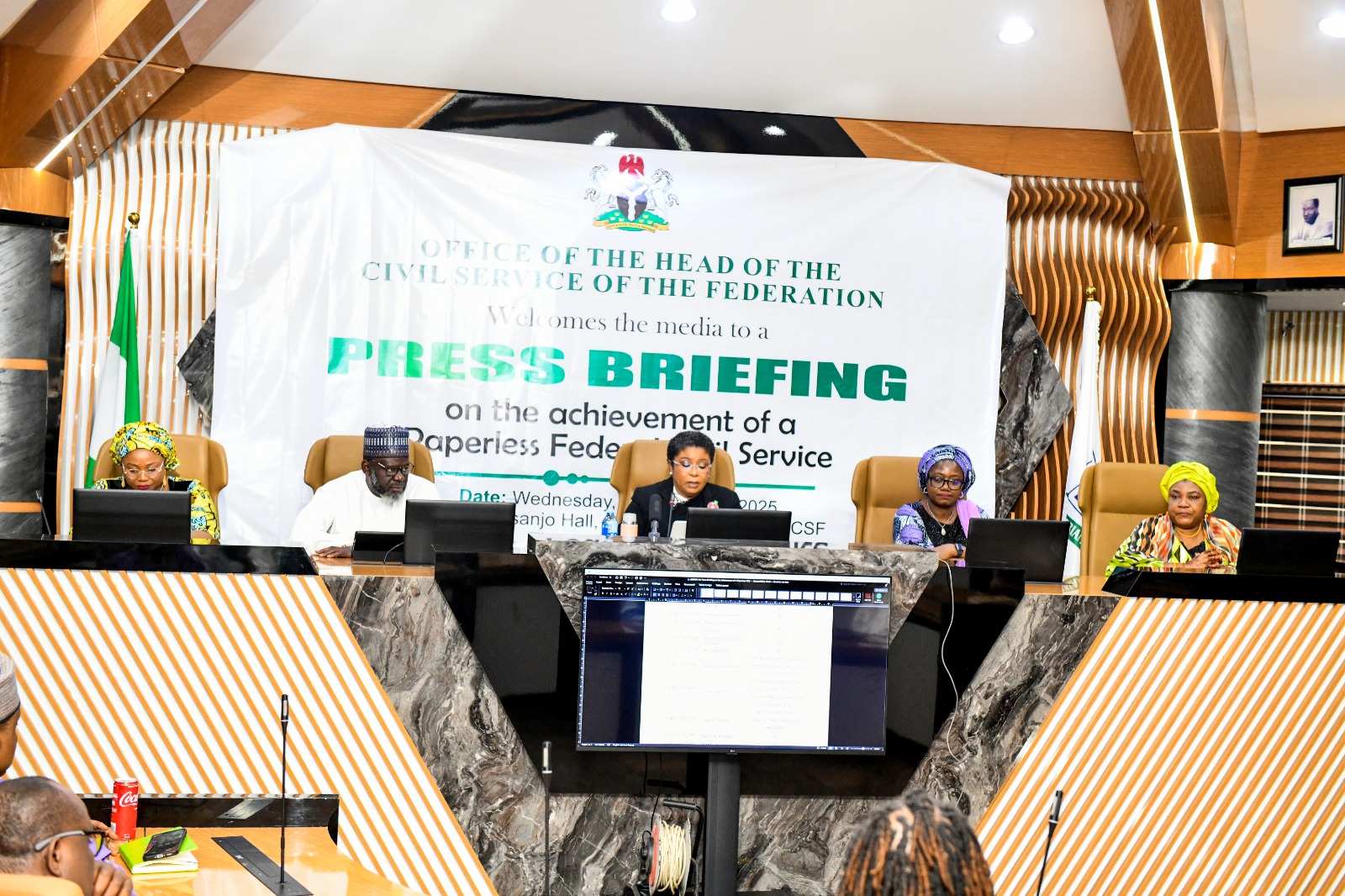
Nigeria’s Federal Civil Service has completed a major transition to paperless operations across 38 Ministries and Extra‑Ministerial Departments (MEMDs), the Head of the Civil Service of the Federation, Mrs Didi Walson‑Jack, announced on Wednesday in Abuja. The move, she said, marks a decisive shift from a paper‑based bureaucracy to a digitally enabled public service that promises greater efficiency, accountability and cost savings.
Nigeria paperless civil service gains scale with GovMail
Walson‑Jack told reporters that the initiative now covers thirty‑three Ministries and five Extra‑Ministerial Departments, including the State House and central administrative offices such as the Office of the Secretary to the Government of the Federation and the Office of the Accountant‑General. The Head of Service said the change will significantly reduce incidents of missing or misplaced files and speed up official decision making.
A central pillar of the paperless drive has been the expansion of the GovMail platform. According to the OHCSF, official government email accounts have grown from fewer than 20,000 in August 2024 to more than 100,000 by 31 December 2025. This universal provision of official email identities aims to secure correspondence, improve inter‑agency responsiveness and reduce dependence on fragmented, externally licensed email solutions.

Walson‑Jack emphasised the financial benefit, saying GovMail is saving the federal government billions of Naira each year by eliminating duplicated subscriptions and delivering better value for money. The government also highlighted improved auditability of communications and strengthened sovereignty over official correspondence as immediate gains.
Paperless submissions and public tracking
As part of implementation, the 38 MEMDs will no longer accept paper submissions through physical registries. All correspondence must be sent to official registry email addresses, which are listed on the Office of the Head of the Civil Service of the Federation website. Citizens will be able to track the progress of their submissions through the Federal Civil Service Paperless portal, improving transparency in interactions with government departments.
To sustain momentum, the OHCSF plans to extend the paperless policy to all Departments and Agencies and to focus on post‑implementation optimisation, compliance monitoring and cybersecurity enhancement. The office also announced a targeted capacity building programme in 2026 to embed new digital practices across the service.
With support from the United Nations Development Programme, the OHCSF will launch a Service‑wide Training‑of‑Trainers programme in January 2026. Five hundred trainers will be equipped to cascade practical, hands‑on training across Ministries and MEMDs. The training will cover key digital tools such as GovMail, the Online Compendium of Federal Circulars and Service‑Wise GPT, as well as Enterprise Content Management and other workflow systems.
Walson‑Jack placed the achievement in historical context, noting that digitalisation was designated a strategic priority in the Federal Civil Service Strategy and Implementation Plan 2017–2020 and was further advanced under the FCSSIP 2021–2025. She said her office inherited just three MEMDs with some paperless operations when she assumed office in August 2024 and has since accelerated the roll‑out.
Officials said the next phase will concentrate on deepening compliance, improving cyber resilience and ensuring that digitisation translates into measurable service‑delivery improvements for citizens. If sustained, the reforms could set a benchmark for digital governance across the region.
Key Takeaways:
- Nigeria paperless civil service now covers 38 MEMDs, including 33 Ministries and five Extra‑Ministerial Departments.
- GovMail rollout expanded official email accounts from under 20,000 in August 2024 to over 100,000 by December 2025, cutting costs and improving security.
- Physical registries will no longer accept paper submissions; citizens can track correspondence via the Federal Civil Service Paperless portal.
- UNDP‑backed training and 2026 capacity building aim to embed digital workflows and strengthen cybersecurity.








