











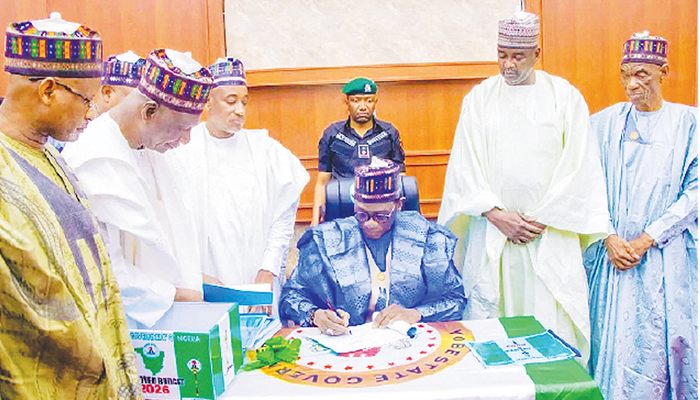
Governor Mai Mala Buni of Yobe State has signed the state’s N515.532 billion Appropriation and Finance Bills for 2026 into law, formalising a plan the government has called the “Budget of Economic Growth and Infrastructural Transformation.” The signing, completed on Tuesday, provides the legal framework for the administration’s planned investments across education, health, agriculture, infrastructure and employment.
Yobe State 2026 budget key allocations
The approved budget was marginally adjusted by the Yobe State House of Assembly from the governor’s original proposal of N515.583 billion to N515.532 billion. The revision reflects a small reduction in capital expenditure and a matching increase in recurrent spending. Capital projects received N291.9 billion, representing roughly 62 per cent of the total, while recurrent services were allocated N223.6 billion, or 38 per cent.
Officials say the capital allocation will fund ongoing and new projects intended to improve public infrastructure and expand economic opportunities. Key sectors highlighted for support include basic and tertiary education, primary healthcare, agricultural development and road works intended to improve connectivity within the state.

Implementation and oversight
Governor Buni praised the state legislature for its cooperation and said the budget provides the statutory backing required to execute government policies and programmes. He emphasised that the administration will guide implementation with principles of accountability, probity and transparency, and will adhere to due process and budgetary discipline.
To support delivery, the Office of the Secretary to the State Government will work with the Ministries of Budget and Planning and Finance to provide policy direction, monitoring and evaluation. The governor cited recognitions from development partners and civil society organisations, including SIFTAS, a World Bank initiative, and BudgIT, as evidence of the state’s record of sound fiscal management.
Legislature signals continued cooperation
The Speaker of the Yobe State House of Assembly, Honourable Ciroman Buba Mashio, reaffirmed the legislature’s commitment to maintaining a harmonious working relationship with the executive to ensure effective service to the people. Lawmakers said the slight adjustments made to the proposed figures were intended to sharpen priorities while preserving the overall objectives of growth and transformation.
Analysts note that the emphasis on capital spending should support job creation and improve public services if projects are executed efficiently. The increase in recurrent spending may provide room for improved salaries, routine maintenance and operational costs that keep public facilities functioning.
With the budget now law, attention will turn to the state’s capacity for implementation. Effective coordination between ministries and agencies, timely release of funds and transparent procurement will be critical for turning budgetary allocations into visible improvements for residents of Yobe State.
The signing marks a clear moment for the administration to translate stated ambitions into tangible outcomes for communities across the state, while maintaining the fiscal discipline that has drawn positive attention from donors and oversight groups.
Key Takeaways:
- Yobe State Governor Mai Mala Buni signed the N515.532bn 2026 appropriation, titled the Budget of Economic Growth and Infrastructural Transformation.
- The Yobe State 2026 budget allocates 62% (N291.9bn) to capital projects and 38% (N223.6bn) to recurrent services, with a slight revision from the original proposal.
- The administration pledges accountability, transparency and continued fiscal discipline, with oversight from the Office of the SSG and relevant ministries.








