











Key Takeaways:
- President Putin sent New Year and Christmas greetings to a wide range of world leaders, including heads of BRICS nations.
- Recipients included leaders from the United States, China, India, Brazil, South Africa, and several post‑Soviet and Latin American states.
- The messages underscore continued diplomatic contact between Moscow and BRICS+ partners ahead of the new year.

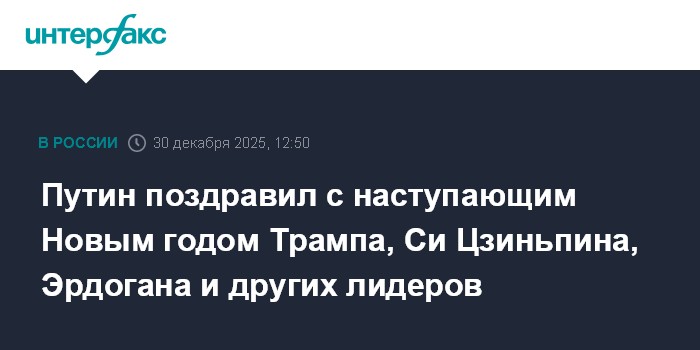
Moscow, 30 December — Russian President Vladimir Putin has sent New Year and Christmas greetings to an extensive list of foreign heads of state and government, including leaders of several BRICS nations and partner countries.
In his telegrammes, President Putin congratulated former US President Donald Trump, Chinese President Xi Jinping, Turkish President Recep Tayyip Erdogan and Indian Prime Minister Narendra Modi. The messages also went to North Korean leader Kim Jong Un and South African President Cyril Ramaphosa, among others.
Putin New Year greetings reach BRICS and beyond
The Russian leader extended his good wishes to a group of post‑Soviet leaders, sending messages to the presidents and prime ministers of Abkhazia, Azerbaijan, Armenia, Belarus, Kazakhstan, Kyrgyzstan, Tajikistan, Turkmenistan, Uzbekistan and South Ossetia. In Europe, telegrammes were sent to Hungarian Prime Minister Viktor Orban and Slovak Prime Minister Robert Fico. The note to the head of the Roman Catholic Church was addressed to Pope Leo XIV according to the Russian statement.
In Latin America, Putin congratulated the presidents of Brazil, Venezuela and Cuba — Luiz Inácio Lula da Silva, Nicolás Maduro and Miguel Díaz‑Canel — as well as Nicaragua’s co‑presidents Daniel Ortega and Rosario Murillo. The Kremlin added that greetings were also sent to selected leaders in Asia and Africa.
Diplomatic exchanges of this kind are routine at the turn of the year, providing leaders with an opportunity to reaffirm ties and offer goodwill ahead of new political and economic cycles. For Russia, such greetings illustrate ongoing contact with a wide network of partners that includes core BRICS members — Brazil, China, India and South Africa — and a broader circle of allied and friendly states.
Putin’s messages follow a pattern of regular diplomatic outreach that the Kremlin has maintained in recent years, balancing high‑level meetings and public statements with personal telegrammes and congratulatory notes. While these messages are largely ceremonial, they serve as a visible reminder of state‑to‑state relationships and can precede or accompany more substantive diplomatic or economic actions in the months ahead.
Observers note that the outreach to BRICS leaders and other partners arrives amid continuing geopolitical tensions and shifting international alliances. Such gestures help to sustain formal lines of communication and may be used to smooth relations or set the scene for future cooperation on trade, energy and regional issues.
As the new year approaches, these formal greetings close the calendar year with a measure of diplomatic continuity. They reflect a blend of traditional protocol and strategic signalling as capitals around the world prepare for the coming year’s political agenda.








