











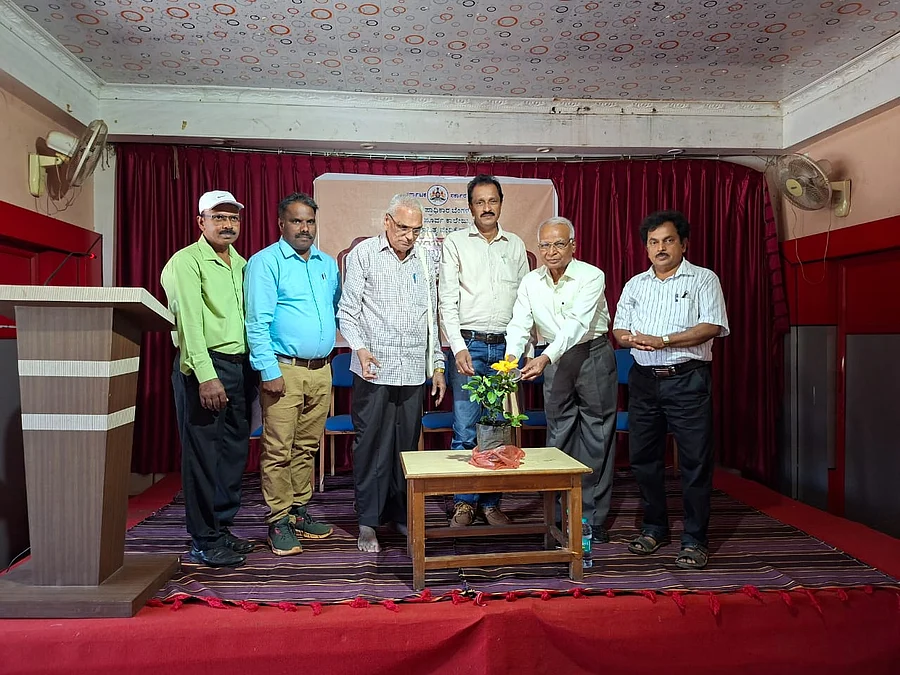
Speakers at a literary gathering in Sagar sounded a note of concern about the state of Kannada in literature, arguing that growing pressures on everyday speech are narrowing writers’ ability to express themselves. The event, organised by Paraspra Sahitya Vedike in collaboration with the Kannada Book Authority and the Government Pre-University College, brought together writers, teachers and students to discuss the theme of language in literature.
Kannada literary language under strain
Author G.S. Bhat told the audience at the town’s Pavitra Sabhangana that subtle forms of control over public speech are increasingly affecting the language of literature. He said such pressures, whether social or institutional, make it harder for writers to render their thoughts fully and sincerely onto the page. “When ordinary speech comes under surveillance, literature loses a part of its voice,” he said, urging attendees to remain alert to these developments.
Speakers emphasised that the relationship between colloquial speech and literary language is not fixed. Students were encouraged to consider how dialects and everyday registers can transform into valid literary forms. The forum urged younger readers and aspiring writers to study past Kannada authors to see how they preserved spontaneity while meeting the demands of literary craft.

Education emerged as a central concern. Lakshman Kodase, an education observer, criticised the semester system for restricting students’ creative outlets. He argued that the current structure has made it difficult for many young people to take part in cultural activities as they once did, and that experts must identify the barriers and propose remedies to revive student engagement in literature and culture.
The meeting included readings and presentations that illustrated the variety of Kannada writing. Yashwanth K. spoke about Kuvempu’s work, while S.N. Disoja read poems that explored local themes. The college principal, Satyanarayana K.C., presented certificates to students who had excelled in Kannada examinations, highlighting the importance of recognising academic achievement alongside creative practice.
Organisers and participants called for an approach to language that balances preservation with openness. They urged teachers to make room for diverse linguistic experiments and for institutions to support forums where students can practise writing and performance. There was also a plea for closer study of how Kannada writers have historically maintained naturalness in language use while meeting literary standards.
Paraspra Sahitya Vedike president Sarfaraj Chandragutti chaired the session. The event concluded with a call to action: to protect the fluid connection between spoken Kannada and its literary expressions and to ensure that educational reforms do not stifle creativity. Participants left the meeting with a shared sense that safeguarding the Kannada literary language requires coordinated effort from writers, educators and institutions.
Contact and follow-up details for the organisers were provided for those wishing to join future sessions or contribute to the proposed studies and reforms.
Key Takeaways:
- Speakers at a Sagar literary event warned that increasing control over everyday speech is eroding the Kannada literary language.
- Experts urged students to study how colloquial speech can evolve into literary language and to preserve natural language use.
- Concerns were raised that semester-based education is limiting students’ creative expression in literature and culture.
- Speakers called for educational reforms and active measures to safeguard Kannada literary language and encourage literary participation.








