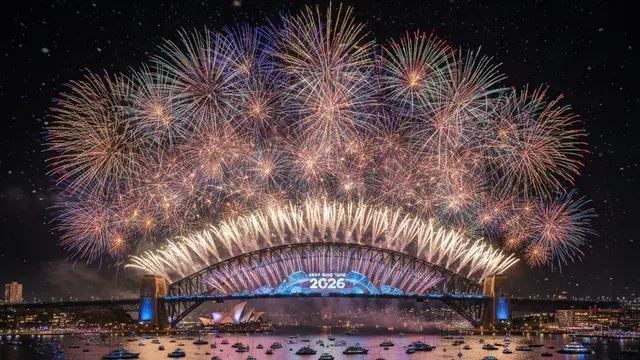
Kiritimati Atoll in the Republic of Kiribati was the first place on Earth to usher in 2026, as islanders welcomed the new year in island time. Local festivities on the Pacific atoll began at midday local time, which corresponded to 03:30 Indian Standard Time (IST) on the day.
Celebrations in Kiribati were followed by other Pacific island communities and then by New Zealand and Australia, continuing a familiar progression of festivities across time zones. As night fell in Asia and the Middle East, major cities lit up with fireworks, gatherings and cultural events marking the first moments of 2026.
New Year 2026 celebrations spread across time zones
The movement of the new year across the globe reflected the differing local times and customs that accompany the calendar change. Using Indian Standard Time as a reference, key timings were noted as follows: Kiritimati (Kiribati) at 03:30 IST; Auckland (New Zealand) at 04:30 IST; Fiji and parts of Russia at 05:30 IST; Melbourne and Sydney (Australia) at 06:30 IST; Japan and South Korea at 20:30 IST; China and Singapore at 21:30 IST; Thailand and Vietnam at 22:30 IST; and India and Sri Lanka at 00:00 IST. These conversions helped viewers in South Asia and elsewhere track the global celebrations in real time.

In many countries the new year was marked by both public and private events. Cities staged official firework displays and public gatherings where permitted, while families and communities celebrated with traditional music, food and local rites. In island communities such as Kiritimati, festivities are often more intimate, blending local cultural practices with the convivial mood associated with the new year.
Several BRICS+ members featured in the timeline. India and Sri Lanka observed midnight celebrations at 00:00 IST, while China and Vietnam welcomed the new year later in the evening according to IST. Parts of Russia, noted in the Pacific time conversions, also observed the transition earlier in the day. The sequence underlined the interconnectedness of global observances despite differing time zones.
For international audiences, broadcasters and digital platforms provided live coverage and countdowns, enabling viewers worldwide to follow the moment as it arrived in each time zone. Social media amplified the atmosphere as people shared photographs and messages from local events, creating a shared sense of occasion.
While the tone of the day was largely celebratory, authorities in some cities maintained public-safety measures and advised citizens to follow local guidelines for gatherings. Travel and tourism officials noted that New Year events often bring a short-term rise in visitor interest to host cities and islands, offering both cultural exposure and economic benefit.
As 2026 began its global journey from the Pacific, the passing of time served as a reminder of how local traditions and international media combine to make the moment a global one. From small atolls to major metropolitan centres, communities across the world marked the start of the year with a mix of ceremony, joy and cautious observance.
Key Takeaways:
- Kiribati’s Kiritimati atoll marked the first New Year 2026 celebrations, welcoming the year at 03:30 IST.
- Pacific island nations, New Zealand and Australia followed, with major Asian cities celebrating later in the evening.
- Several BRICS+ members including India, China, Russia, Thailand and Vietnam observed the transition at their respective local times.
- The story highlights global time‑zone progression and the communal nature of New Year 2026 celebrations.